Showing posts with label multi-media. Show all posts

Thursday, 19 April 2012

The Rebirth of Frankenweenie and Tim Burton's Stop-Motion Dreamscapes

With his full-fledged zombie dog remake on its way to cinemas, BreakThru Films examines Tim Burton's ongoing love affair with stop-motion animation.
The revivified Frankenweenie makes his
 way to the cinemas this October
It seems fitting for a director whose career is so shrouded in darkness and long creeping shadows that Tim Burton's first film is not merely lost in the mists of time, but may in fact exist only in myth. If Burton's own account in the 2006 book Burton on Burton, his film-making began with The Island of Dr. Agor, a stop-motion animation based on H.G. Wells similarly titled story of genetically modified body-horror The Island of Dr. Moreau, however many have speculated that the film is little more than an April Fools Day prank. Whether fragments eventually emerge or the myth is dispelled, one fact seems certain, that by the tender age of 11 Burton was already deeply interested in the art of animation, just as he had immersed himself in classic American B-movies, Japanese mega-monster extravaganzas as the peculiar camp of Roger Corman's Edgar Allen Poe films, with their lugubrious star Vincent Price. While he was dropping out of Burbank High School he was also expanding his knowledge of film-making, taking in the stop-motion masterpieces of Ray Harryhausen as well as traditional hand-drawn animation. On graduation, Burton proceeded to the California Institute of the Arts, where he was to make his first surviving animated short, the punningly titled Stalk of the Celery Monster.
Dark, disturbing and deliciously comic, Celery Monster
showcased Burton's emerging distinctive style
Though only images and fragments of the film remain extant, the influence of German expressionist cinema and Universal Pictures monster movies is clear in Burton's surreal aesthetic. Shadows leap in points, architecture and design has a touch of the European art nouveau and the characters are irrefutably ghoulish. Burton's film caused quite a stir, and soon caught the eye of Disney Animation Studios, who rapidly hired Burton as an apprentice animator. He cut his teeth at Disney creating story-boards and concept art for a number of their less successful early 80's animations, but it was with his first solo film, 1982's animated short Vincent that Burton was able to indulge his passion for gothic horror and his admiration for stop motion animation and its potential to realize the playful yet unsettling aesthetic of his pencil drawings. Though Celery Monster had been successful in capturing some of the scratchy, nightmarish intensity of Burton's drawing style, the slightly jerky, marionette-like quality of stop-motion, suggestive of the early days of silent cinema and the expressionist horrors of F.W. Murnau's Nosferatu or Robert Weine's Cabinet of Dr. Caligari gave Vincent an instantly recognizable yet utterly fresh aesthetic.

Vincent is haunted by animated visions from Burton's
twisted imagination
Adapted from one of Burton's own poems, Vincent was originally intended as a children's book, however the director was afforded a modest budget to create the short film, and in many ways the aesthetic which he established in it would come to define much of his work through the 1980's and beyond. Though Burton's next film, the original live-action Frankenweenie was judged a money-wasting flop by Disney executives and led to Burton's firing, he was soon to return to a wilder visual style with the major cinematic hits Pee-Wee's Big Adventure and Beetlejuice.

The original Frankenweenie has gained something of
a cult following despite a disastrous initial reception
Both of these mega-hits brought Burton back to the world of stop-motion animation, which they used to add an exaggerated Tex Avery-style strand of mayhem to the live action proceedings that surrounded them. In Beetlejuice, the central couple who find themselves suddenly thrust into the Other Side are trapped in their house by a monstrous plasticine sandworm, and at one point twist their faces into grotesque elastic monster-masks in order to perform their 'bio-exorcism'. The stop-motion effects in Beetlejuice contribute hugely to its success and its ability to maintain a light carnivalesque visual tone despite the themes of death, suicide and the bleak Kafka-esque bureaucracy of the afterlife.

The stop-motion sand worm strikes in Beetlejuice
The success of these two films, both critical and commercial, reinvigorated major studio interest in Burton, and he went on to direct two blockbuster Batman films and the surprise smash-hit Edward Scissorhands, an elegiac gothic romance which saw Burton's dark aesthetic clash brilliantly against the pastel and picket-fence world of American suburbia. It was in the writing and production of Disney's A Nightmare Before Christmas, however, that Burton would return to stop-motion animation in a film which was to become his trade-mark. Part Christmas-film, part Halloween-horror, part-musical and all rendered in exquisite stop-motion, Burton's film was practically a love-letter to the medium, and is often credited with sparking a major resurgence of interest in its potential for film-makers and advertisers. 

Henry Selick and Tim Burton with the set of
A Nightmare Before Christmas
The story of the King of Halloween's bungled attempts to try his hand at Santa's role, it involved the use of highly stylized puppets, performing against a backdrop composed of the twisted hills and spiked gratings of Burton's idiosyncratic drawing style. Burton chose this style of animation partially to reference the American favourite Rankin/Bass Productions, whose holiday specials included stop-motion renditions of classic stories such as The Little Drummer Boy. This gave the film a direct relevance to those audiences which had grown up watching these classic Christmas treats, and made Burton's subversion of Holiday iconography all the more delicious.

Still from Rankin/Bass's Little Drummer Boy, a far-cry from the
twisted world of Jack and Sally
A similar style of stop-motion animation was used in Burton's co-production James and the Giant Peach, where Burton's flair for the macabre was kept on a tighter leash, but which nevertheless displayed some masterful animation, particularly in the huge flock of seagulls straining to keep the peach afloat. James returned to the mixed-medium approach of Beetlejuice in its use of stop-motion to bring to life the more fantastical elements of the young boy's adventures once he has entered the peach, while his more prosaic life with Aunt Sponge and Aunt Spiker was presented with live action. It's a successful approach which acknowledges the slightly numinous quality of the form, its suggestion of a world of the imagination or the unconscious which exists at right-angles to prosaic reality.
There was a cameo for Jack Skellington in Burton's next
stop-motion animation,
James and the Giant Peach
Though budgetary concerns scuppered Burton's ambition to realize the alien invaders of Mars Attacks! with stop-motion, he was soon to return to the form in a major way with the creation of dark fairy-tale Corpse Bride. A conscious successor to Nightmare Before Christmas, Corpse Bride took the same aesthetic and animation style and set it to a more serious and in many ways more adult tale of love and loss. Corpse Bride was also the first Burton film to feature Tim Allen, who has worked with BreakThru  on both The Magic Piano and The Flying Machine, on its animation team; he has recently returned to work with Burton on Frankenweenie.

Burton chose a more muted and cold aesthetic for Corpse Bride, demonstrating
the flexibility of stop-motion and its ability to achieve a variety of tones
Corpse Bride was a big hit for Burton, and though his subsequent films displayed a stronger reliance on computer generated animation techniques, the upcoming Frankenweenie is a clear indication that he still holds stop-motion in the very highest regard. Just over a week ago another exciting announcement indicated that Burton's next major project will also be of interest to fans of traditional animation, as the director indicated that he was looking forward to moving into pre-production on a new ghoulish stop-motion feature titled Night of the Living. Cheerfuly tweaking the conceit of George A Romero's zombie classic, this new film boasts a script from Burton's Dark Shadows collaborator Seth Grahame-Smith and is expected to go before the cameras in 2013.

As well as proving one of Hollywood's most bankable directors, with a slew of box-office smashes and oodles of critical acclaim to his credit, Tim Burton is also worthy of respect for his constant and vocal championing of the magic of stop-motion and other hand-animation techniques. Time-consuming, labour-intensive and often expensive, these could easily have fallen from fashion and from the radars of major studios had they not boasted such a credible and imaginative advocate.

- Stewart Pringle


Saturday, 7 April 2012

Pirates!, Aardman and the power of mixed-media animation

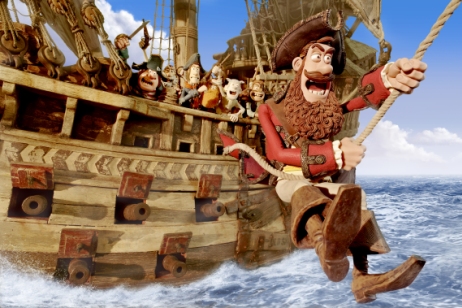
The Pirates! In an Adventure with Scientists is well on its way to being a box-office smash, and shows the brilliant Aardman Animation at their very best, but it's also a significant technical triumph, and a great demonstration of the strength of blending classic stop-motion techniques with cutting edge computer technology.
The Pirate Captain prepares to board...
Filled with the dry wit, hilarious visual gags and good-hearted adventure that has made Aardman Britain's leading animation studio, The Pirates! In an Adventure with Scientists was released in the UK last week, and looks sure to be as much of a hit with audiences as with critics. Based on the first of a series of comic novels by Gideon Defoe (hence it's idiosyncratic title, which would sit much more comfortably on a bookshelf than a cinema hoarding, and which is being changed to the more manageable The Pirates! Band of Misfits for its US release) it also has the potential to become a sizeable franchise.

If it does, then its success will be well-deserved. The Pirates! is a gleeful piece of swashbuckling family entertainment, every frame stuffed with brilliant jokes that demand a second or third viewing and a fantastic cast including a star-turn by Hugh Grant as the hapless Pirate Captain and the incredible Imelda Staunton as a pirate-hating Queen Victoria. It also has a winning script which refuses to talk down to its audience, keeping the parents interested with cameo appearances by the Elephant Man and Jane Austen rather than cheap 'adult' humour.

Perhaps best of all, and easiest to pass over, is its gorgeous animation, which manages to stay true to the stop-motion which made Aardman's name in the 1980's and 90's while providing eye-bursting 3D and seamlessly introducing a variety of computer generated landscapes and effects. 

It's not Aardman's first foray into mixed-media animation: the apparently 'home-spun' Wallace & Gromit in the Cure of the Were-Rabbit involved the participation of leading post-production company MPC Films, who provided a plethora of computer generated bunnies to 'bulk out' those created by Nick Park and his team.
Can you separate the CG bunnies from their plasticine cousins?
I'm not sure we can...
In The Pirates! however, Aardman incorporated mixed-media techniques throughout the animation process. Computer generation was handled in-house, made possible by Aardman's earlier experiments with computer generated animation for their modestly successful all-CG collaboration with Dreamworks, Flushed Away. As so much of Pirate Captain's adventures take place on the water, a famously time-consuming substance to work with in traditional stop-motion, it naturally suggested the full-on incorporation of computer generated visuals. 

The ocean swells, the sweeping vistas of Victorian London and a host of other elements have been rendered digitally rather than in-camera, and it is a credit to the skill of Aardman's team that the effect is never jarring. Aardman have essentially updated an intrinsic principle of animation, in which the background is 'pre-rendered', whether this means painted onto a single surface or onto multiple panes of glass as in many of Disney's most lush environments, while the characters are animated by hand and overlaid. Here it was the motley band of pirates and their (not very sea-worthy) ship that were superimposed over the computer generated environment using green screen.
Animators work to blend the set and characters into the
computer generated ocean environment - here Charles Darwin
is readied to walk the plank into a digital ocean
It doesn't stop there, the animation has also been rendered in highly effective 3D, and contains numerous moments which imitate traditional cell-animation. These include the comic travelling sequences, in which the pirate ship careers around a map, leaving a confused trail of red dots as it ricochets off cherubs and is blown around by baroque zephyrs. The result is a technical palette which pays homage to great animations of the past, contains a visual style which is definitively 'Aardman-esque' (all ping-pong ball eyes and letterbox jaws) while also allowing for spectacular set-pieces. Most importantly of all, the various techniques compliment one another, rather than creating incongruities.

Mixed-media animation is something BreakThru Films feel very strongly about, so we'll be cheering The Pirates! on to success when it opens in the US later this month. Our current projects, and particularly the short animations created for Chopin's Études, have been created with a wide variety of technical processes, blended together to create visually distinctive films which are both aesthetically powerful and technically progressive. The Flying Machine sees live-action blending with computer generated graphics and 3D stop motion animation, continuing a lineage which extends back through Who Framed Roger Rabbit, Mary Poppins and beyond.
Our stop motion animated Flying Machine against
a computer generated vista
We're also very excited about Scarecrow, which has recently been selected for the BeFilm 2012 Underground film festival in New York at the end of this month. It's to be shown in 3D, as intended, and we hope it can demonstrate (as The Pirates! does) that 3D really can be the future of animation, if studios have the confidence to develop their films in true-3D, rather than simply slapping on the effect in post-production to increase box-office revenue. Used effectively, in collaboration with the other animation techniques, it can be spectacularly effective and moving.
Rotoscoping, a technique which has been used since
the birth of animation, gives
Scarecrow a real sense
of living history
Scarecrow uses a combination of traditional animation, rotoscoping and 3D computer generated graphics to tell the story of a fallen soldier in Poland's November Revolution. The rotoscope technique allowed the animators to bring the startling paintings of Polish painter Jerzy Duda-Gracz to life, creating an aesthetic that at once stays true to the era Chopin evokes, while at the same time involving the work of one of Poland's most significant modern artists. As the story progresses and the soldier's soul seems to rise up from his broken body, directors Przemyslaw Anusiewicz and Janusz Martyn begin to introduce 3D computer generated elements, strange cloaked figures which dance above the marshland like animated shrouds. Viewed in 3D, it is an effect which simply could not be achieved with traditional animation, a true example of technology making the impossible possible.
Computer generated animation brings a more haunting aspect of
Duda-Gracz's art to life in striking 3D
Whether allowing pirate ships to spring forty feet above a crystal-clear ocean, or bringing a haunting vitality to some of Poland's most beautiful art and music, mixed-media techniques are keeping animation at the cutting edge of film-making. The sense that an animated film can embrace a wide variety of technical forms is one which keeps it fresh and responsive to innovation and creative thinking.  The days in which stop-motion or traditional animation and computer generation were seen as mortal enemies, with the latter poised to consign its frame-by-frame predecesor to the dustbin of history, are thankfully far behind us. At BreakThru we're constantly looking forward to the next advancement, and as Aardman's Pirates! seem poised to storm the US box office, we're proud to be among such illustrious company.

-Stewart Pringle

Follow the BreakThru Films blog for future articles on some of the revolutionary techniques that we;re developing for upcoming projects. Except the ones that are too secret to show you yet...shhh!


Thursday, 5 April 2012

The Flying Machine - a multi-platform adventure

BreakThru Films founder and producer of The Flying Machine Hugh Welchman explains that the way we tell stories is changing all the time.
The Flying Machine will be taking off in more than cinemas
Our aim with The Flying Machine is to make a film that will push the boundaries of family animation, and for the range of products across different platforms that we are currently developing to be the first phase of the creation of an enduring franchise. We are in a period of massive change in the way that people are accessing and interacting with stories, music, art and games. Technology is not only changing the way we consume stories, it is changing the way stories are told.

BreakThru Films is all about delivering multiple entertainment and educational experiences across a range of platforms, traditional and new. The combination of cutting edge live action, amazing computer generated visual effects, state‐of‐the‐art 3‐D technology, Chopin’s timeless composing and Lang Lang’s kinetic piano playing, will create a truly moving and entertaining film for families of all ages.

The core iconic element across all delivery platforms is the flying machine itself. In the beginning nothing but a discarded piano, but when children discover it in moments of distress it transforms into something magical ‐ in the vein of Jules Verne and Hayao Miyazaki ‐ and transports them to a world without limits. It is the ultimate adventure den, and it will strike a chord with the imaginative child in each of us.

A metaphor for Chopin’s mesmerising and transporting music, the flying machine, like his music, will traverse Europe and the world. The audio, visual and cultural experience will have a transformative effect on people’s lives; flying into films, games and theatrical shows, onto the pages of books and the screens of mobiles, and into school curriculums. The Flying Machine is so distinctive it will win the hearts and spark the imagination of audiences all over the world.

We are breaking the mould with The Flying Machine. The sheer emotional impact and enjoyment of watching this unique film will make it a classic. Like Disney and Pixar’s most innovative films it is set to charm audiences through the generations.

- Hugh Welchman