Showing posts with label stop motion. Show all posts

Monday, 14 May 2012

Tim Allen - Interview with an Animator

BreakThru talks to animator extraordinaire Tim Allen about his life in animation, Tim Burton and his incredible work on Peter & The Wolf and Magic Piano.

Tim Allen on the set of Corpse Bride
- When did you first become interested in stop-motion animation? Were you interested in art as a child?

Yeah, I was always drawing, making models and reading comics. I think my earliest ambitions were to make comic strip cartoons along the lines of Garfield, and I copied this format with vampire and ghost characters. As a teenager I’d moved on to Batman and my dream had now progressed to drawing superheros (or maybe being one!). I opted out of conventional A-levels in favour of a 2 year Art Diploma, as we knew I was going down the road of an artistic career. At this stage, I honestly can say I hadn’t even considered you could animate for a living!  

Somewhat lost for what to do after my art course, I was looking at modelmaking degrees and accidently stumbled upon an animation degree. At this time Nightmare Before Christmas had recently come out in cinemas & the idea of working on something like that just blew me away. Cheesy as it sounds, it was a moment of complete certainty, a true calling. I looked around & found a very good stop motion course at Glamorgan University and my very first animated steps began...


- How did you first 'break into the industry'? Was there a particular project that helped solidify your interest into a career?

It was tough getting going and those that get a break shortly after college I think are the very lucky ones. As I graduated, the industry was just starting a quiet patch which was leaving lots of established professionals on the job hunt. I contacted & tried to visit pretty much every stop motion company in the UK. In retrospect it was good experience in that it taught me who was who in the stop motion world as I literally knocked on almost everyone’s door. I did a fair bit of work experience & trainee model making where I learned quite a bit about studio practise.

I guess I did the classic of casting my net wide and after 1 and a half years I finally made a catch! I was asked to come for an animation audition for Ealing Animation in London. I think I got the job for two reasons - I would work very hard to impress and I was cheap!

One of Tim's first jobs in animation came with the BBC's
fondly remembered stop-motion education show 'El Nombre'
It was a low budget educational programme called El Nombre and so long as we told the educational part properly we had some creative freedom within the rest of the episode. For months, my animation was mostly long drawn out shots of gerbils counting money, very slowly. Fortunately the characters were charming and I had some very interesting and challenging sequences to work on for the action parts of the story. I was one of only two animators on the show so had my fair share of variety and tricky animation. A junior animator wouldn’t normally get the difficult stuff, but they only had two of us to delegate to! After 8 months the series finished & I was looking for work again, but this time I had some half decent shots under my belt & could pretend I was a professional!


- How did your involvement with Tim Burton begin? Were you a fan of his work before you were recruited for Corpse Bride?

I’ve always had a huge appreciation for Nightmare Before Christmas as it was the project that inspired me into this business. I loved Tim’s visual style and to work on a giant set from a Nightmare or Corpse Bride movie felt like the ultimate career moment at that time. Back then the only place that made feature films was Aardman. They already had a full time animation crew in place, which left most other animators around the UK (myself included) working on children’s TV series. This meant that when Corpse Bride came along it was a big deal – a chance to work on a big Hollywood size Tim Burton movie! I’d now been animating children’s series for 6 years and this movie felt like the opportunity of a lifetime!

However my showreel was rejected, as was my second attempt and only 6 months later did my third showreel (I kept working on it and updating it) earn me an audition. I had to do a nerve-racking 3 day test, but this time around, I made the right impression. It didn’t end there of course as you need to continue earning the directors trust for him to delegate what sequences you get to animate.


- Can you describe what an average day is like for an animator? Do you specialise in one particular area of it or is there a lot of variety?

On a film you often get typecast and could spend most of your time with a handful of characters. On Corpse Bride I was mostly cast as Barkis the sinister psychopath for 6 months. On Magic Piano I developed how to animate the Flying Machine & spent a good 6 months pushing it to the limits! On children’s series & commercials you can get a lot of variety quickly which is great for learning your craft.

An average day? It always depends on the project and the company you’re working for. Each studio has slightly different working practices so I could answer differently for each production. Here’s a generalisation:
Tim worked extensively on bringing the villainous
Barkis Bittern to life in
Corpse Bride

As an animator my role tends to function like that of an actor in a live action film and I must be cast for the role. This is all based on what the director needs and I will work to his/her instructions to try and find the best way to approach the shot. From here I’ll plan the shot out with the camera crew to ensure I’ll be keeping the puppet in focus and making good use of the lighting. Next the model/puppet makers and riggers will help me with any details so that I can create the shot as close to the director’s needs as possible.

A quick note about time keeping: There’s normally pressure to get things done as quickly as possible (for understandable financial reasons!). In fact the key to making beautiful stop motion fast is all in the preparation time. It’s like struggling through an obstacle course when you’d be better off removing the obstacles and just sprinting to the finish line. You’ve got to take responsible decisions to get the balance right.

Once I start animating, you’re kind of on your own – for many many hours until the work is complete. You have to embrace & love the creative freedom to ‘perform’ your shot as a live action actor would. You have specific instructions that you need to get right but at the end of the day you’ll be relying heavily on your instincts. In truth you’re normally under pressure to get it done as quickly as possible!


- Could you tell us a little about your involvement with BreakThru Films? How was it working with Suzie on Peter and the Wolf?

I came onboard Peter & the Wolf about 2 months into the shoot and it was quite an exciting time in those early stages. I was the first animator to come over from outside Poland for the project. Suzie was great and had such a clear vision of how every detail should be. The challenge for me was being able to give her the detailed performance she needed in the limited time we had.

Initially Suzie was hoping I could do lots of work establishing the wolf, but the puppet wasn’t quite ready and I started working with Peter. She liked my close up acting work and basically I think most of my time was spent doing close-ups of Peter face. It was tricky as only the eyeballs could move and Suzie needed very specific emotional reactions from a completely static face! The shot that stands out in my memory is where Peter sees Duck, his childhood pet and closest companion, eaten alive right in front of him. Suzie asked for Peter to display utter shock, then overwhelming horror, followed by a shiver creeping up his spine, climaxing into trembling realisation. All this when the only facial movement I can get is moving the head and eyeballs!


- And what are your thoughts on The Flying Machine?

Oh quite simply it’s the most challenging project I’ve ever worked on! It wasn’t just because I was animation supervisor this time round, though certainly that in itself was an interesting new challenge. It wasn’t just that it was my first time shooting in 3D or that every action had to naturally sync with Chopin’s music. No the film had so many unbelievably ambitious but potentially beautiful sequences. To try and coordinate shots with thousands of flowers blowing in the wind, or epic long shots or the entire junk yard coming to life was complexity on a grand scale - and I didn’t even animate those pieces myself!

Most of my time in the studio was taken up trying to get a 2 metre high flying machine puppet to soar through the sky convincingly. It was a fascinating yet intimidating character/machine/force of nature (we called it all these and more!). We had a lot of practical hurdles to overcome (I sense I’m making a gross understatement here!) and it was really tough getting such a big complicated model to do what I wanted. I sometimes get more satisfaction seeing the shots before post production than after, the only reason being that you can see all the rigs moving that control it. Then you get a very real sense of what a technical accomplishment it was.

But the real beauty of the film was that Director Martin Clapp had worked so hard to make these sequences flow to the music and tell some beautiful moments. Each shot was utterly complex, but you knew it was justified and would be worth it. I’m very very proud of all we did on Magic Piano and feel lucky to have been so heavily involved with it.


- You've most recently completed work on Burton's Frankenweenie, can you tell us a little about the animation approach in this new film?

The cloth will come off Tim's work on
Frankenweenie when it's released this October
Well I can’t give too much about the film away yet, but again I’m really excited to be a part of this gem of a movie. It may initially look similar visually to Corpse Bride, but the animation is much more dynamic and lively. It really tested your timing as an animator. I did a lot of work with central characters Victor and his pet dog Sparky. This meant animating a four legged character who had to behave like a loveable but realistic dog. I looked at live action videos of real dogs regularly to try and get Sparky’s running and mannerisms accurate.


- Do you think there's a bright future for stop-motion animation, and if so, what can explain it's continued appeal?

It looks like we’re starting a golden age of stop motion now. There’s going to be a lot of films coming out of America, as well as several European ones on the cards soon. After a dry spell for children’s series, there’s suddenly many happening in the UK simultaneously. Aardman continue to keep as busy as ever too. We could be looking at 6-10 years rife with stop motion productions.

As for the appeal, I guess it’s the age old tangible quality, that you feel you can touch it and you can see it’s not perfect. I think people find a model set and a puppet very immersive. You can literally walk on that set and more easily imagine being in that world. We all had toys or dolls we had a close attachment to as children & perhaps puppets tap into this primal bond with our imagination.

It’s been such a blast working with so many different talented people and I feel so Iucky I found an art form I love and can earn a living from. I even went to Ray Harryhausen’s house recently to discuss stop motion techniques with him – I mean how cool is that?! It is not an easy career and won’t suit most people but there can be a lot of highlights. I’m trying to settle down more but there’s a lot of stuff tempting me right now. I believe even BreakThru Films aren’t done with stop motion...!

Tim’s website: www.TimAllenAnimation.co.uk

Follow Tim’s adventures in the world of stop motion on Twitter: @TimAnimation


Saturday, 7 April 2012

Pirates!, Aardman and the power of mixed-media animation

The Pirates! In an Adventure with Scientists is well on its way to being a box-office smash, and shows the brilliant Aardman Animation at their very best, but it's also a significant technical triumph, and a great demonstration of the strength of blending classic stop-motion techniques with cutting edge computer technology.
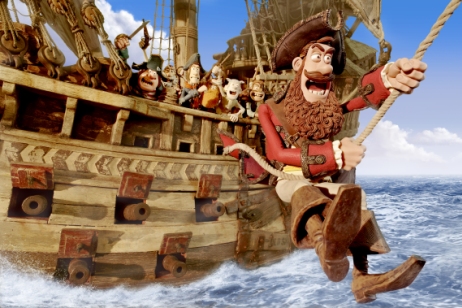
The Pirate Captain prepares to board...
Filled with the dry wit, hilarious visual gags and good-hearted adventure that has made Aardman Britain's leading animation studio, The Pirates! In an Adventure with Scientists was released in the UK last week, and looks sure to be as much of a hit with audiences as with critics. Based on the first of a series of comic novels by Gideon Defoe (hence it's idiosyncratic title, which would sit much more comfortably on a bookshelf than a cinema hoarding, and which is being changed to the more manageable The Pirates! Band of Misfits for its US release) it also has the potential to become a sizeable franchise.

If it does, then its success will be well-deserved. The Pirates! is a gleeful piece of swashbuckling family entertainment, every frame stuffed with brilliant jokes that demand a second or third viewing and a fantastic cast including a star-turn by Hugh Grant as the hapless Pirate Captain and the incredible Imelda Staunton as a pirate-hating Queen Victoria. It also has a winning script which refuses to talk down to its audience, keeping the parents interested with cameo appearances by the Elephant Man and Jane Austen rather than cheap 'adult' humour.

Perhaps best of all, and easiest to pass over, is its gorgeous animation, which manages to stay true to the stop-motion which made Aardman's name in the 1980's and 90's while providing eye-bursting 3D and seamlessly introducing a variety of computer generated landscapes and effects. 

It's not Aardman's first foray into mixed-media animation: the apparently 'home-spun' Wallace & Gromit in the Cure of the Were-Rabbit involved the participation of leading post-production company MPC Films, who provided a plethora of computer generated bunnies to 'bulk out' those created by Nick Park and his team.
Can you separate the CG bunnies from their plasticine cousins?
I'm not sure we can...
In The Pirates! however, Aardman incorporated mixed-media techniques throughout the animation process. Computer generation was handled in-house, made possible by Aardman's earlier experiments with computer generated animation for their modestly successful all-CG collaboration with Dreamworks, Flushed Away. As so much of Pirate Captain's adventures take place on the water, a famously time-consuming substance to work with in traditional stop-motion, it naturally suggested the full-on incorporation of computer generated visuals. 

The ocean swells, the sweeping vistas of Victorian London and a host of other elements have been rendered digitally rather than in-camera, and it is a credit to the skill of Aardman's team that the effect is never jarring. Aardman have essentially updated an intrinsic principle of animation, in which the background is 'pre-rendered', whether this means painted onto a single surface or onto multiple panes of glass as in many of Disney's most lush environments, while the characters are animated by hand and overlaid. Here it was the motley band of pirates and their (not very sea-worthy) ship that were superimposed over the computer generated environment using green screen.
Animators work to blend the set and characters into the
computer generated ocean environment - here Charles Darwin
is readied to walk the plank into a digital ocean
It doesn't stop there, the animation has also been rendered in highly effective 3D, and contains numerous moments which imitate traditional cell-animation. These include the comic travelling sequences, in which the pirate ship careers around a map, leaving a confused trail of red dots as it ricochets off cherubs and is blown around by baroque zephyrs. The result is a technical palette which pays homage to great animations of the past, contains a visual style which is definitively 'Aardman-esque' (all ping-pong ball eyes and letterbox jaws) while also allowing for spectacular set-pieces. Most importantly of all, the various techniques compliment one another, rather than creating incongruities.

Mixed-media animation is something BreakThru Films feel very strongly about, so we'll be cheering The Pirates! on to success when it opens in the US later this month. Our current projects, and particularly the short animations created for Chopin's Études, have been created with a wide variety of technical processes, blended together to create visually distinctive films which are both aesthetically powerful and technically progressive. The Flying Machine sees live-action blending with computer generated graphics and 3D stop motion animation, continuing a lineage which extends back through Who Framed Roger Rabbit, Mary Poppins and beyond.
Our stop motion animated Flying Machine against
a computer generated vista
We're also very excited about Scarecrow, which has recently been selected for the BeFilm 2012 Underground film festival in New York at the end of this month. It's to be shown in 3D, as intended, and we hope it can demonstrate (as The Pirates! does) that 3D really can be the future of animation, if studios have the confidence to develop their films in true-3D, rather than simply slapping on the effect in post-production to increase box-office revenue. Used effectively, in collaboration with the other animation techniques, it can be spectacularly effective and moving.
Rotoscoping, a technique which has been used since
the birth of animation, gives
Scarecrow a real sense
of living history
Scarecrow uses a combination of traditional animation, rotoscoping and 3D computer generated graphics to tell the story of a fallen soldier in Poland's November Revolution. The rotoscope technique allowed the animators to bring the startling paintings of Polish painter Jerzy Duda-Gracz to life, creating an aesthetic that at once stays true to the era Chopin evokes, while at the same time involving the work of one of Poland's most significant modern artists. As the story progresses and the soldier's soul seems to rise up from his broken body, directors Przemyslaw Anusiewicz and Janusz Martyn begin to introduce 3D computer generated elements, strange cloaked figures which dance above the marshland like animated shrouds. Viewed in 3D, it is an effect which simply could not be achieved with traditional animation, a true example of technology making the impossible possible.
Computer generated animation brings a more haunting aspect of
Duda-Gracz's art to life in striking 3D
Whether allowing pirate ships to spring forty feet above a crystal-clear ocean, or bringing a haunting vitality to some of Poland's most beautiful art and music, mixed-media techniques are keeping animation at the cutting edge of film-making. The sense that an animated film can embrace a wide variety of technical forms is one which keeps it fresh and responsive to innovation and creative thinking.  The days in which stop-motion or traditional animation and computer generation were seen as mortal enemies, with the latter poised to consign its frame-by-frame predecesor to the dustbin of history, are thankfully far behind us. At BreakThru we're constantly looking forward to the next advancement, and as Aardman's Pirates! seem poised to storm the US box office, we're proud to be among such illustrious company.

-Stewart Pringle

Follow the BreakThru Films blog for future articles on some of the revolutionary techniques that we;re developing for upcoming projects. Except the ones that are too secret to show you yet...shhh!


Thursday, 5 April 2012

The Flying Machine - a multi-platform adventure

BreakThru Films founder and producer of The Flying Machine Hugh Welchman explains that the way we tell stories is changing all the time.
The Flying Machine will be taking off in more than cinemas
Our aim with The Flying Machine is to make a film that will push the boundaries of family animation, and for the range of products across different platforms that we are currently developing to be the first phase of the creation of an enduring franchise. We are in a period of massive change in the way that people are accessing and interacting with stories, music, art and games. Technology is not only changing the way we consume stories, it is changing the way stories are told.

BreakThru Films is all about delivering multiple entertainment and educational experiences across a range of platforms, traditional and new. The combination of cutting edge live action, amazing computer generated visual effects, state‐of‐the‐art 3‐D technology, Chopin’s timeless composing and Lang Lang’s kinetic piano playing, will create a truly moving and entertaining film for families of all ages.

The core iconic element across all delivery platforms is the flying machine itself. In the beginning nothing but a discarded piano, but when children discover it in moments of distress it transforms into something magical ‐ in the vein of Jules Verne and Hayao Miyazaki ‐ and transports them to a world without limits. It is the ultimate adventure den, and it will strike a chord with the imaginative child in each of us.

A metaphor for Chopin’s mesmerising and transporting music, the flying machine, like his music, will traverse Europe and the world. The audio, visual and cultural experience will have a transformative effect on people’s lives; flying into films, games and theatrical shows, onto the pages of books and the screens of mobiles, and into school curriculums. The Flying Machine is so distinctive it will win the hearts and spark the imagination of audiences all over the world.

We are breaking the mould with The Flying Machine. The sheer emotional impact and enjoyment of watching this unique film will make it a classic. Like Disney and Pixar’s most innovative films it is set to charm audiences through the generations.

- Hugh Welchman

Friday, 30 March 2012

Enter our Easter competition!

To celebrate the return of the Peter and the Wolf Live experience, BreakThru Films are giving Twitter users the chance to win a pair of tickets for an Easter weekend performance in the Royal Festival Hall, Southbank Centre. It's guaranteed to be a magical production, with a screening of the animated classic given a live accompaniment by the acclaimed Aurora Orchestra and live narration from the incredible Mackenzie Crook (Pirates of the Carribean, The Office).

All you need to do is follow @BreakThruFilms and retweet the following message to be in with a chance of winning.

Follow @breakthrufilms & RT me for the chance to WIN 2 tickets to Peter and the Wolf Live this Easter!  #peterwolflive

The winner will be selected at random and receive two tickets to the performance this coming Easter Monday. There will also be a chance to meet Peter and the Wolf producer Hugh Welchman and see the miniature stars of the Oscar-winning animation.

Full terms and conditions can be found on our website but it really is as simple as that, the competition closes on the morning of April 5th so there's no time to lose - get tweeting!

- BreakThru Films

Wednesday, 28 March 2012

'Rig-Zilla' - the monster behind The Flying Machine


Jacek Spychalski, Art director on The Flying Machine (and the man in charge of actually making the flying contraption), talks about his experiences bringing the magical piano to life.

I have had the pleasure of being a part of this project from its very beginning. At that stage, though, I didn’t suspect the venture was going be so huge and that it would totally engross me totally for nearly two years. Working on The Flying Machine was a huge challenge and the flying machine itself was of course a key component of the film and a real troublemaker for its constructors and builders, as well as for the animators who threw life into it.
Lang Lang and Heather Graham aboard The Flying Machine
The biggest technical challenge was animation the flying machine as a puppet. It would have been relatively straight-forward and inexpensive to make and animate the flying machine puppet in computer animation, but there were certain qualities that puppet stop-motion delivers that meant we wanted to pursue this route. Puppet stop motion allows for a much higher level of finishing and detail to the models, and a much more life-like feel, it also has a special quality to its movement, which comes from the fact it is being manipulated by hand. Animating the flying machine in stop motion would make it magical.
Using stop motion rather than computer generated animation
gave Heather and Lang's journey its magical look
Most puppets are under 50cm high, have 4 limbs, not more than 12 joints, are self- supporting and weigh under 500 grams. So now you see the comparison: our first flying machine puppet was 2 metres high, had over 120 joints, each of which needed to be moved for each frame of animation, and 13 wings, and needed to be supported in 15 places and weighed 25 kilos.  This meant that we had to devise a specialist rig (the ‘rig-zilla’), which was 4 metres high, a kind of articulate robot, that could run along two sets of tracks, hold the flying machine exactly still over a metre off the ground, and be adjusted to precisely move the flying machine in any direction.
Rig-Zilla before the cameras
Our animators had to use step-ladders to animate each frame, and out of 18 lead animators only 2 animators learnt how to use this monster of rigs. It was an epic feat of technical production with each shot using rig-zilla, especially as most shots we used it for were complex motion control shots, often we need a to block out a space the size of a tennis court half for these monster shots.
The Flying Machine suspended by Rig-Zilla
When starting the work on The Flying Machine, I didn’t imagine that one of our machines was going to fly from a studio in Łódź to the very heart of Beijing, the Forbidden City Concert Hall, and that I was going to fly after it few days later to put it together on the eve of our film’s world premiere. After this long period of hard toil there finally came the time for its fruits to be tasted and for the film’s creators to celebrate the final part of the adventure. It was a great pleasure to see the smiling faces of children watching the film, trying to catch flower petals whirling around them (thanks to our 3D specialists).
- Jacek Spychalski